We produce durable, efficient, and innovative machines.
-
Esenyurt / İstanbul


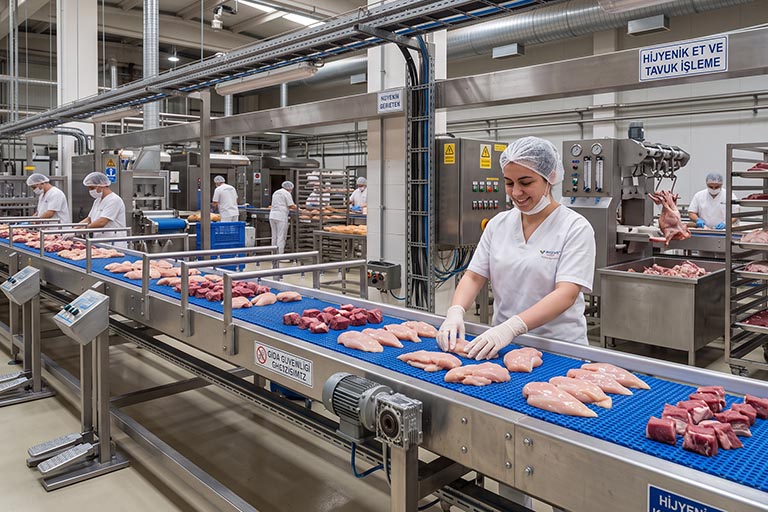
Conveyor Systems for Meat and Poultry Processing Plants
Conveyor systems for meat and poultry processing plants are essential equipment used to transport products in an organized, controlled, and efficient manner between different stages of the production line. In facilities where processes such as slaughtering, cutting, processing, classification, quality control, packaging, and shipping are carried out, a properly designed conveyor system contributes to the continuity and efficiency of the production flow.
Due to the sensitive nature of meat and poultry products, varying product weights, operating conditions, and hygiene requirements, conveyors used in these facilities need to be considered differently from standard material handling systems. Factors such as conveyor belt material, load capacity, belt width, line geometry, cleanability, automation infrastructure, and integration with other machinery should be evaluated together.
Arpack Makine is a manufacturer that develops conveyor systems, automatic feeding systems, and packaging machines according to the requirements of different production lines. Conveyor solutions for meat and poultry processing plants can be engineered to ensure that transportation, product handling, feeding, and packaging processes work together efficiently.
Why Are Conveyor Systems Important in Meat and Poultry Processing Plants?
The production process in meat and poultry processing plants consists of numerous sequential operations. Manually transporting products from one processing point to another can increase labor requirements and cause disruptions in production flow, particularly in high-capacity production facilities.
Conveyor systems help create a more systematic production process by ensuring that products move at a predetermined speed and in a controlled direction.
The main functions of conveyor systems in meat and poultry processing plants may include:
- Transporting products between production processes
- Directing products to specific points
- Providing consistent product feeding to processing and packaging machines
- Transferring products to classification and inspection points
- Organizing product flow before packaging
- Connecting different production lines
- Reducing the need for manual product handling
- Enabling coordinated product transfer with automation systems
Therefore, a conveyor system is not simply a piece of equipment used to transport products. It is an important part of the mechanical and automation infrastructure that forms the overall production flow.
Where Are Conveyor Systems Used in Meat and Poultry Processing Plants?
Conveyor systems can be used at different points of a facility depending on its production process. Since every plant has different products, capacities, layouts, and production methods, conveyor systems should be designed according to the specific process requirements.
Product Transportation in Processing Lines
Conveyors can be used to transfer processed meat, poultry products, or products at different stages of processing from one production point to another.
The belt width, load capacity, and operating speed of the conveyor are determined according to the characteristics of the products. This helps ensure a more controlled product flow throughout the production line.
Classification and Sorting Lines
Conveyor systems play an important transportation role in production lines where meat and poultry products are classified according to different characteristics.
Delivering products consistently to inspection or sorting points helps different operations within the production line work in coordination.
Quality Control Points
Conveyor systems can be used in areas where visual inspections or other quality control operations are performed during the production process.
Moving products through inspection points at a controlled speed can enable operators or automated equipment to evaluate products more systematically.
Transportation Before Packaging
Meat and poultry products need to reach the packaging line in an appropriate and controlled arrangement before packaging.
Conveyor systems used at this stage transport products to the packaging machine and help make the feeding process more consistent.
Transportation After Packaging
Conveyor systems can also be used to transport packaged products to labeling, boxing, inspection, palletizing, or shipping areas.
This configuration can enable products leaving the packaging line to be transferred automatically or semi-automatically to subsequent operations.
Types of Conveyor Belts for Meat and Poultry Processing Plants
The conveyor system used in meat and poultry processing plants can be manufactured in different configurations depending on the product characteristics and production process.
Straight Conveyor Systems
Straight conveyors can be used to transport products between two or more production points located at the same level.
Their simple and modular structures allow them to be adapted to different production lines.
Incline Conveyor Systems
Incline conveyors can be used when products need to be transported between processing points located at different heights.
The appropriate inclination and belt design are determined according to the existing facility layout, product characteristics, and direction of transportation.
Turn Conveyor Systems
Turn conveyor systems can be used in areas where the production line needs to change direction.
Especially in facilities with limited floor space or production lines that need to be distributed in different directions, turn conveyor solutions can help use the available production area more efficiently.
Modular Conveyor Systems
Modular conveyor systems can be adapted to different line lengths and production processes.
Designing the system with future modifications or capacity increases in mind can make it easier to expand the production infrastructure when required.
Hygienic Design in Meat and Poultry Processing Conveyors
One of the most important considerations when designing conveyor systems for meat and poultry processing plants is cleaning and hygiene management.
Equipment that comes into contact with products or operates in product handling areas should be designed to facilitate cleaning and maintenance.
For this reason, the following features should be evaluated when designing conveyor systems for meat and poultry processing plants:
- Easy-to-clean surfaces
- Appropriate belt materials
- Minimization of unnecessary gaps and product accumulation points
- Easy access to mechanical components
- Construction suitable for cleaning and maintenance operations
- Material selection suitable for the production environment
- Suitability of product-contact surfaces for the production process
In addition to conveyor design, selecting materials and components that are suitable for the production process is also essential.
How Should Conveyor Belt Material Be Selected?
When selecting conveyor belts for meat and poultry processing plants, load capacity alone is not sufficient.
Product characteristics, operating temperature, cleaning methods, moisture, the amount of product transported on the belt, and production conditions should all be evaluated together.
Depending on the production process, different conveyor solutions with PVC, PU, modular plastic belts, or stainless steel constructions can be considered.
PU Conveyor Belts
PU belts are among the conveyor belt options that can be considered for applications in food production processes.
When selecting a belt, product contact conditions, cleaning requirements, and the operating conditions of the production process should be evaluated together.
PVC Conveyor Belts
PVC belts are one of the alternatives that can be used in various transportation applications.
Selecting the appropriate belt structure according to the operating conditions of the production line is important for conveyor performance and service life.
Modular Plastic Belts
Modular plastic belt systems can be used in transportation applications due to their adaptable structures.
Modular solutions can be particularly useful in projects where the conveyor geometry or production line configuration requires customized engineering.
Stainless Steel Construction
The conveyor frame and supporting structure used in meat and poultry processing plants need to be suitable for the operating environment.
Stainless steel constructions can be considered for projects involving humid production environments and processes requiring frequent or intensive cleaning.
The appropriate material selection should be based on the process conditions of the facility and its cleaning procedures.
Why Are Product Characteristics Important When Transporting Meat and Poultry Products?
The characteristics of the products being transported must be considered when designing a conveyor system.
Meat and poultry products can vary in size, weight, shape, and surface characteristics. Therefore, a single conveyor design may not be suitable for every application.
The following criteria may be evaluated during the engineering process:
- Product weight
- Product dimensions
- Product shape
- Product distribution on the belt
- Transportation speed
- Distance between products
- Product sensitivity
- Production capacity
- Feeding requirements of the packaging machine
Especially in high-speed packaging lines, controlled product movement on the conveyor is important for the efficient operation of subsequent processes.
Conveyor Integration with Automatic Feeding Systems
Conveyor systems in meat and poultry processing plants can be designed to operate together with automatic feeding systems.
The main purpose of an automatic feeding system is to help transfer products to a packaging or processing machine at a specific speed and in a controlled arrangement.
Products arriving via the conveyor can be:
- Separated
- Sorted
- Directed
- Advanced at predetermined intervals
- Transferred to the packaging machine
This configuration can contribute to more controlled product flow, particularly in high-volume production facilities.
Conveyor Belt and Flowpack Packaging Machine Integration
Packaging is one of the key stages in meat and poultry production processes. Products need to be fed consistently to the packaging machine in order to make efficient use of its capacity.
For this reason, establishing proper integration between the conveyor belt system and the flowpack packaging machine is important.
While the conveyor system transports products to the packaging section, the automatic feeding system can help arrange products according to the speed and feeding requirements of the packaging machine.
The following parameters are evaluated together during this integration:
- Conveyor speed
- Product spacing
- Feeding capacity
- Sensor positions
- Packaging machine speed
- Product orientation
- Line synchronization
A properly designed transportation and feeding infrastructure can help reduce irregularities in product flow that may affect packaging line performance.
Automation in Conveyor Systems
Modern meat and poultry processing plants rely on more than mechanical conveyor equipment alone. Automation systems can also be used to coordinate conveyors with other machines throughout the production line.
Automation components such as PLCs, sensors, motor drives, and servo systems can be integrated into conveyor systems according to project requirements.
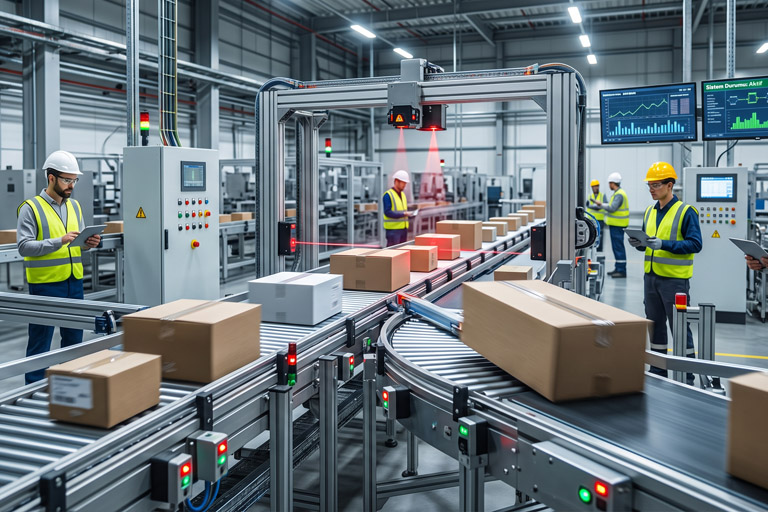
Sensors can be used to detect product presence, product spacing, or the status of products at specific transportation points. A PLC-based control infrastructure can help synchronize the operation of different machines.
As a result, the conveyor system becomes an integral part of the overall automation infrastructure of the production line.
What Should Be Considered When Designing Conveyor Systems for Meat and Poultry Processing Plants?
When designing a conveyor system for a meat or poultry processing plant, both the current production structure and future requirements of the facility should be considered.
Production Capacity
The conveyor’s load and transportation capacity should be compatible with the current and planned production capacity of the line.
Belt Width
The appropriate belt width should be determined according to product dimensions and how products will be positioned on the belt.
Transportation Speed
The conveyor speed should be compatible with the operating speeds of other machines in the production line.
Line Layout
The conveyor may need to operate in straight, inclined, turning, or multi-level configurations. The appropriate line geometry should be determined according to the physical structure of the facility.
Cleaning and Maintenance
From an operational perspective, the conveyor should be designed to provide easy access for cleaning and maintenance procedures.
Automation Compatibility
The conveyor system can be engineered to communicate and operate in coordination with packaging machines, feeding systems, and other automation equipment used in the production line.
Future Capacity Expansion
If the facility is expected to add new machinery or increase production capacity, it is beneficial to consider these potential requirements during the initial conveyor system design.
Advantages of Conveyor Systems in Meat and Poultry Processing Plants
A properly designed conveyor system can help different stages of the production line operate in a more organized manner.
Key advantages may include:
- Making product transportation processes more systematic
- Reducing the need for manual handling
- Supporting continuous product flow throughout the production line
- Providing consistent feeding to packaging machines
- Enabling more efficient use of production space
- Operating in integration with automation systems
- Connecting different production processes
- Creating infrastructure suitable for future capacity increases
- Making operational processes more controlled
However, achieving these advantages requires the conveyor system to be designed not simply for product transportation, but as part of the overall production flow of the facility.
Common Mistakes When Selecting Conveyor Systems for Meat and Poultry Processing Plants
Making a decision based only on price or conveyor length can result in a system that does not meet the production line’s requirements in the long term.
Common mistakes include:
Selecting a Conveyor Based Only on Belt Length
In addition to conveyor length, transportation capacity, belt width, speed, and product characteristics are also important.
Ignoring Other Machines in the Production Line
If the conveyor does not operate properly with the packaging or feeding machine, it can create bottlenecks in the production line.
Overlooking Cleaning and Maintenance Requirements
Designing a conveyor without considering cleaning and maintenance requirements can create operational difficulties during daily plant operation.
Failing to Consider Future Capacity
If production capacity is expected to increase, it is important to evaluate whether the existing conveyor system will be capable of meeting future requirements.
Ignoring Product Characteristics
Different meat and poultry products may have different transportation requirements. Therefore, product characteristics should be one of the fundamental criteria in conveyor system design.
Arpack Makine Manufactures Conveyor Systems for Meat and Poultry Processing Plants
Arpack Makine is a manufacturer that develops conveyor systems, automatic feeding systems, and packaging machines for different production processes.
Conveyor systems for meat and poultry processing plants can be engineered according to product characteristics, production capacity, facility layout, packaging processes, and automation requirements.
The systems developed by Arpack Makine are designed with the objective of ensuring compatibility between mechanical engineering, conveyor manufacturing, automatic feeding, and packaging processes.
Especially in production lines where conveyor belts, automatic feeding systems, and flowpack packaging machines need to operate together, evaluating the entire system according to the production process can help create a more controlled and efficient production flow.
Make Your Production Lines More Systematic with Conveyor Systems for Meat and Poultry Processing Plants
Conveyor systems for meat and poultry processing plants play an important role not only in transporting products safely and systematically throughout the production line, but also in connecting automatic feeding and packaging processes.
The right conveyor system should be designed by evaluating product characteristics, production capacity, belt material, transportation speed, facility layout, cleaning and maintenance requirements, and automation infrastructure together.
Arpack Makine is a manufacturer developing conveyor systems, automatic feeding solutions, and flowpack packaging machines for meat and poultry processing plants, providing integrated solutions that connect different stages of the production line.
By defining the requirements of your meat and poultry processing facility, you can develop a transportation and feeding solution tailored to your production line.