We produce durable, efficient, and innovative machines.
-
Esenyurt / İstanbul


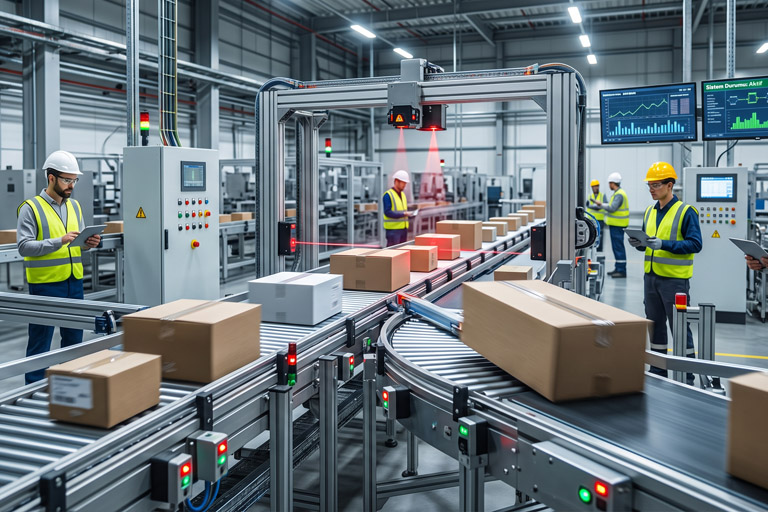
How Do Sensor-Based Conveyor Systems Work?
Sensor-based conveyor systems are intelligent material handling solutions that enable the transportation, position detection, and automated control of products on industrial production lines. Sensors detect the presence, position, movement, or specific physical characteristics of products traveling along a conveyor and transmit this information to the automation system. Based on this data, conveyor speed, product sorting mechanisms, and the operating sequences of other production equipment can be controlled.
The integration of conveyor systems with industrial automation is becoming increasingly important in food, cosmetics, packaging, pharmaceutical, chemical, and various other manufacturing industries. Particularly in high-capacity production lines, transferring products to the right location at the right time and ensuring consistent feeding into packaging machines are critical factors in production efficiency.
Sensor-based conveyor systems help manufacturers manage product flow more effectively when integrated with automatic feeding systems and packaging machines.
Arpack Makine is a manufacturer specializing in conveyor systems, automatic feeding systems, and flowpack packaging machines for industrial production lines. Material handling systems designed with appropriate sensors and automation technologies can be customized according to the production requirements of different industries.
What Is a Sensor-Based Conveyor System?
A sensor-based conveyor system is an industrial material handling solution in which specific information is detected through sensors during product transportation and used by automation systems to control operations.
In conventional conveyor systems, products generally move at a predetermined speed. In sensor-based systems, however, different control operations can be performed according to product position and the current conditions of the production line.
For example, when a product moving along a conveyor is detected by a sensor, the automation system can use this information to stop the product at a designated position, redirect it, or transfer it to a packaging machine.
The main components of sensor-based conveyor systems include:
- Conveyor mechanism: Physically transports products along the production line.
- Sensors: Collect information about product presence, position, or other characteristics.
- PLC control system: Processes sensor signals and generates control commands.
- Motors and drive systems: Control conveyor movement and operating speed.
- Actuators: Perform operations such as stopping, separating, or redirecting products.
- Operator control panel: Allows operators to monitor the system and adjust operating parameters.
By working together, these components enable conveyor systems to respond automatically to different conditions throughout the production process.
How Do Sensor-Based Conveyor Systems Work?
The operating principle of sensor-based conveyor systems relies on detecting product movement and processing the collected information through a control system.
Products traveling along the conveyor are detected by sensors installed at designated locations. Signals generated by these sensors are transmitted to a PLC or another suitable control unit.
The control system then sends commands to motors, drives, or product sorting mechanisms according to predefined operating scenarios.
The general operating process consists of the following steps:
- A product enters the conveyor system.
- A sensor at the entry point detects the presence of the product.
- The sensor transmits a signal to the control system.
- The PLC processes the information according to product position and production line conditions.
- Conveyor speed or product sorting mechanisms are controlled.
- The product is transferred to the designated processing or packaging station.
- Additional sensors may verify the product’s movement or position.
- The production process continues automatically.
This structure enables manufacturers not only to transport products but also to coordinate material handling operations with other equipment throughout the production line.
Types of Sensors Used in Conveyor Systems
Different sensor technologies are used in industrial conveyor systems depending on the detection requirements of each application.
When selecting sensors, manufacturers should consider product material, dimensions, color, surface characteristics, conveyor speed, and environmental operating conditions.
1. Photoelectric Sensors
Photoelectric sensors use light to detect the presence of products or identify when an object passes a specific point.
These sensors are widely used in conveyor systems for product counting, object detection, and passage monitoring.
For example, when a product traveling along a packaging line is detected by a photoelectric sensor, the control system can initiate the necessary operations to transfer it to the packaging machine.
Photoelectric sensors are available with different operating principles. Through-beam, retro-reflective, and diffuse-reflective sensors can be selected according to specific application requirements.
2. Inductive Sensors
Inductive sensors are used for the non-contact detection of metallic objects.
In conveyor systems that transport metal components, inductive sensors can monitor product presence or detect the position of specific mechanical components.
They are particularly suitable for automotive manufacturing, metal processing, and machinery production lines.
3. Capacitive Sensors
Capacitive sensors can detect certain metallic and non-metallic materials in suitable applications.
They may be used in manufacturing processes that require the detection of plastic, glass, or other materials.
However, factors such as product characteristics and environmental humidity can affect sensor performance. Therefore, selecting the appropriate sensor model and configuration is essential.
4. Ultrasonic Sensors
Ultrasonic sensors use sound waves to detect the presence of objects or measure distances.
They can be used in conveyor applications involving products with different colors and surface characteristics.
These sensors are particularly useful in systems that require distance measurement or monitoring the accumulation of products within a designated area.
5. Laser Sensors
Laser sensors can be used for precise distance and position measurements in specific industrial applications.
Laser-based detection technologies may be preferred in automation systems where accurate product positioning is required.
6. Encoders
Encoders are feedback devices used to measure rotational movement or changes in mechanical position.
In conveyor systems, they provide information about motor movement or conveyor mechanism displacement to the control system.
Encoders are particularly useful in applications where product position must be tracked in relation to conveyor movement.
PLC Automation in Sensor-Based Conveyor Systems
A PLC, or Programmable Logic Controller, is one of the fundamental control components used in industrial automation systems.
In sensor-based conveyor systems, the PLC processes signals received from sensors and controls the operation of the conveyor and other connected equipment.
For example, a sensor installed at the end of a conveyor may detect when a product reaches the packaging machine.
The PLC can use this information to:
- Control conveyor movement.
- Regulate product feeding sequences.
- Activate product sorting mechanisms.
- Exchange control signals with packaging machines.
- Stop specific conveyor sections when product accumulation occurs.
- Provide operators with status information or error notifications.
This allows the conveyor to operate as an integrated component of the production line’s automation infrastructure rather than as an independent material handling machine.
Product Counting and Tracking in Sensor-Based Conveyor Systems
One of the important applications of sensor-based conveyor systems is product counting and tracking.
Products passing a designated point on the production line can be detected and counted using sensors.
This information can be used to monitor production output, track packaging capacity, or control specific manufacturing operations.
For example, in an automatic packaging line, sensor data can be used to monitor the number of products reaching the packaging station within a specific period.
However, reliable product counting requires correct sensor positioning and the ability to distinguish individual products.
Sensor selection and product spacing become particularly important when products travel very close to one another.
How Is Conveyor Speed Controlled Using Sensors?
Conveyor speed is one of the parameters that directly affects production capacity and product flow.
Information collected from sensors can be combined with suitable control algorithms to adjust conveyor operation.
For example, when product accumulation is detected at the entrance of a packaging machine, the control system can slow down or stop a specific conveyor section.
Similarly, when insufficient products reach the packaging machine, the system may adjust the feeding speed under suitable operating conditions.
Motor drives and control systems work together in these applications.
However, adjusting conveyor speed according to sensor data requires a suitable motor, drive, and control infrastructure.
Product Sorting and Diversion in Sensor-Based Conveyors
In industrial production lines, products may need to be transferred to different processing stations.
Sensor-based conveyor systems can detect product positions and activate the appropriate sorting or diversion mechanisms.
For example, if products need to be directed toward two different packaging machines, sensors and PLC control systems can manage the transfer process.
Mechanical diverters, pneumatic pushers, or servo-controlled actuators may be used in these applications.
When designing a product sorting system, manufacturers should consider product dimensions, conveyor speed, product sensitivity, and the required production capacity.
Which Industries Use Sensor-Based Conveyor Systems?
Sensor-based conveyor systems are used across various industrial manufacturing sectors where automation and controlled product handling are required.
Food Manufacturing Facilities
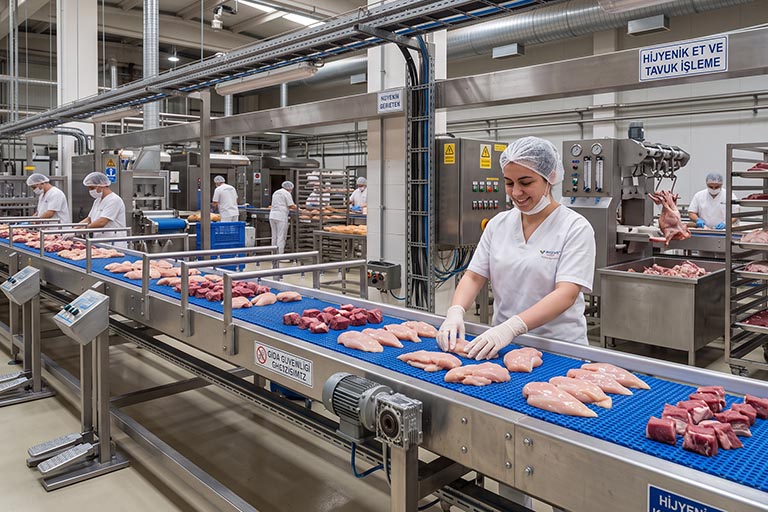
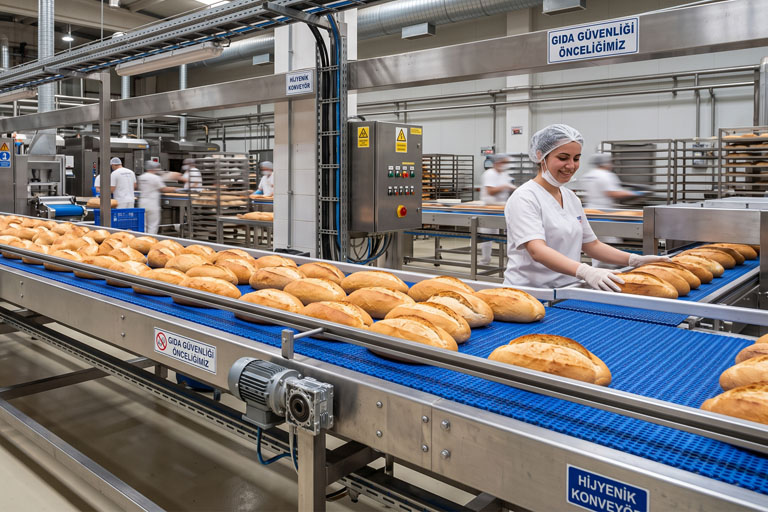
In food production lines, sensor-based conveyors can be used to transport, count, sort, and transfer products to packaging machines.
Product detection and feeding control are important applications in the production of biscuits, chocolate, bakery products, and various packaged food items.
In particular, sensor-equipped conveyor systems integrated with flowpack packaging machines can help ensure that products reach the packaging station in a consistent and organized manner.
Cosmetics Manufacturing Facilities
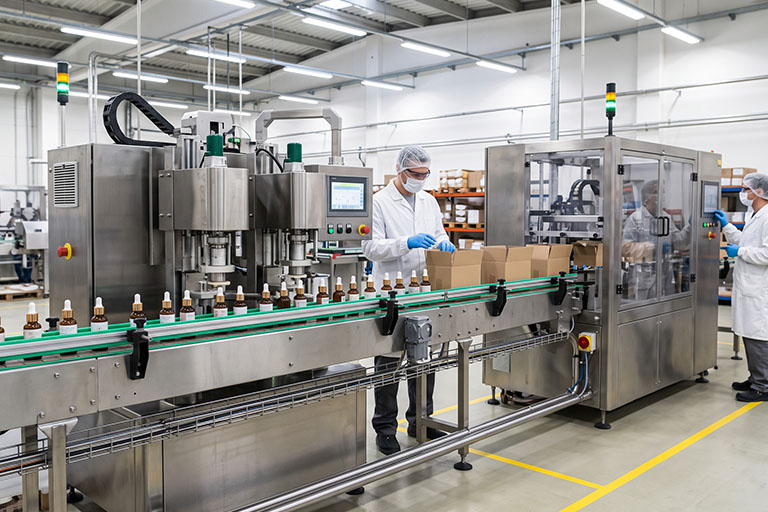
In the cosmetics industry, sensor-based conveyor systems can transport bottles, boxes, soap, cream containers, and personal care products.
Sensors can be used during product transfer between filling, labeling, inspection, and packaging stations.
Packaging Industry
In packaging lines, transferring products to packaging machines at the correct time is essential.
Sensors detect product presence and movement, supporting coordination between automatic feeding systems and packaging equipment.
Pharmaceutical and Medical Product Manufacturing
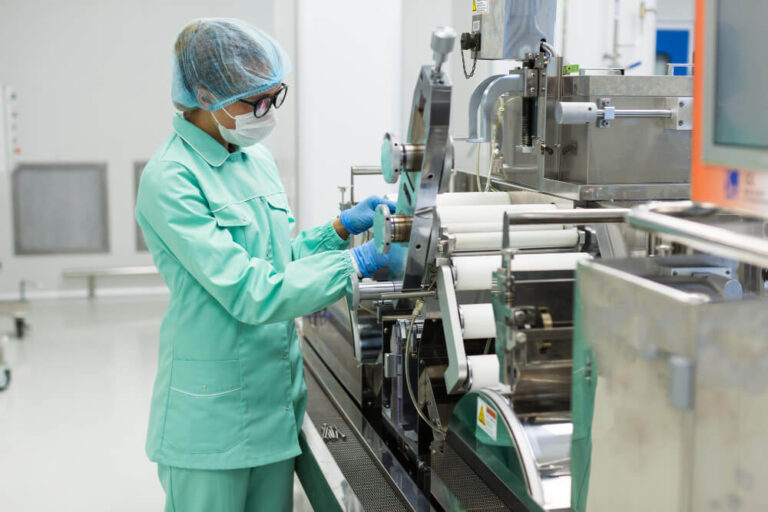
Sensor-based conveyors can be used to transport pharmaceutical and medical products through designated inspection and packaging stations.
In these applications, process-specific verification, traceability, and quality control requirements should also be evaluated.
Automotive and Metalworking Industries
In manufacturing lines that handle metal components, sensors can monitor product position, movement, and specific mechanical operations.
Sensor-based conveyor solutions are particularly useful in automated assembly and component transfer systems.
Integration of Sensor-Based Conveyors with Automatic Feeding Systems
The primary function of automatic feeding systems is to transfer products to production or packaging machines in a controlled and organized sequence.
Sensor-based conveyors support automatic feeding systems by providing information about product flow.
For example, sensors can detect the presence of products traveling along a conveyor and help determine the operating sequence of the feeding mechanism.
This integration can support the following operations:
- Maintaining consistent spacing between products.
- Monitoring product presence at feeding points.
- Transferring products in the correct sequence.
- Detecting product accumulation along the production line.
- Ensuring consistent feeding into packaging machines.
- Coordinating the operation of different conveyor sections.
In high-speed packaging lines, it is particularly important to design sensors, PLC controllers, and automatic feeding systems as an integrated solution.
Integration of Sensor-Based Conveyors with Flowpack Packaging Machines
Flowpack packaging machines require products to arrive at the machine in a controlled sequence and at an appropriate speed.
Therefore, conveyor systems, automatic feeding mechanisms, and packaging machines must operate in coordination.
Sensor-based conveyor systems provide the control system with information about product presence and position during transfer to the packaging machine.
For example, when a product reaches the entrance of a flowpack packaging machine, a sensor can detect its presence. This information can then be used to manage the product feeding mechanism according to the configured control sequence.
Sensor-based conveyors can perform several functions in flowpack packaging lines:
- Detecting incoming products.
- Controlling the spacing between products.
- Managing feeding system operating sequences.
- Coordinating conveyor and packaging machine speeds.
- Detecting product accumulation.
- Regulating product flow before packaging.
For reliable integration, product characteristics, sensor positions, conveyor speed, and packaging machine capacity must be evaluated together.
Advantages of Sensor-Based Conveyor Systems
Properly designed sensor-based conveyor systems can provide several operational benefits in industrial production lines.
Improved Product Flow Control
Sensors detect the presence or movement of products at designated locations.
This information helps conveyor systems operate according to actual production line conditions.
Reduced Need for Manual Monitoring
Certain product detection, counting, and sorting operations can be performed automatically.
As a result, the need for manual monitoring and intervention in specific processes may be reduced.
Better Coordination with Packaging Machines
Communication between conveyors, automatic feeding systems, and packaging machines helps maintain a more consistent product flow.
Product Accumulation Detection
Sensors installed at specific locations can detect product accumulation or situations where products stop moving along the conveyor.
The control system can then respond according to the programmed operating sequence.
Production Data Monitoring
Sensor data can be used to count products and track specific production events.
Increased Automation Capabilities
Sensor-based conveyors help connect different production equipment to a centralized automation infrastructure.
What Should Be Considered When Selecting a Sensor-Based Conveyor System?
When designing a sensor-based conveyor system, manufacturers should evaluate both mechanical characteristics and detection and control requirements.
Product Characteristics
Product size, shape, color, material, and surface properties play an important role in sensor selection.
Conveyor Speed
In high-speed conveyor applications, sensor response time and control system processing capacity are particularly important.
Sensor Type
The appropriate sensor technology should be selected according to the characteristics of the products and the purpose of the detection process.
Sensor Positioning
The location of sensors along the conveyor is essential for accurate product detection.
PLC and Control Infrastructure
A suitable control infrastructure is required to process sensor data and manage conveyor movement.
Integration with Other Machines
If the conveyor system will operate with automatic feeding equipment and packaging machines, control signals and operating sequences should be planned in advance.
Operating Environment
Dust, moisture, temperature, vibration, and cleaning conditions can influence sensor selection.
Maintenance and Calibration
Sensors should be installed in accessible locations to facilitate cleaning, maintenance, and adjustments when necessary.
Common Problems in Sensor-Based Conveyor Systems
Detection and control errors in sensor-based conveyor systems can affect overall production line performance.
Common problems include:
- Sensors failing to detect products.
- Incorrect product counting.
- Dirt or dust accumulating on sensor surfaces.
- Incorrect sensor positioning.
- Sensors that are unsuitable for conveyor operating speeds.
- Wiring or electrical connection problems.
- Incompatibilities in PLC control logic.
- Synchronization problems between conveyors and packaging machines.
To minimize these issues, sensors should be selected according to application requirements, mechanical design should be carefully planned, and the automation system should be tested during commissioning.
How Do Sensor-Based Conveyor Systems Improve Production Efficiency?
Production efficiency depends on more than machine operating speed. Consistent and controlled product transfer between different processing stations is equally important.
Sensor-based conveyor systems provide information about product movement, helping control systems coordinate production operations more effectively.
For example, when product accumulation occurs at the entrance of a packaging machine, sensors can detect the situation. If the control system is configured appropriately, it can slow down or stop the preceding conveyor section.
Similarly, when products are not reaching the packaging machine, the system can detect the absence of products and perform suitable control operations.
This approach can help reduce unnecessary waiting times and improve coordination between production equipment.
However, achieving measurable efficiency improvements requires a comprehensive evaluation of the sensors, conveyor mechanism, and automation infrastructure.
Sensor-Based Conveyor and Automatic Feeding Solutions by Arpack Makine
Arpack Makine is a manufacturer specializing in conveyor systems, automatic feeding systems, and flowpack packaging machines for industrial production facilities.
Ensuring that products are transported at the right time and in a consistent sequence is essential for efficient automatic feeding and packaging operations.
For this reason, product characteristics, transportation capacity, production speed, facility layout, and automation requirements should be evaluated together when designing conveyor systems.
In sensor-based material handling systems, photoelectric sensors, product detection sensors, PLC control infrastructure, and suitable motor drives can be incorporated according to project requirements.
Arpack Makine approaches conveyor systems, automatic feeding solutions, and flowpack packaging machines as interconnected components that can be designed to operate in coordination.
This integrated approach supports the comprehensive planning of product transportation, feeding, and packaging operations across different manufacturing processes.
Smart Industrial Automation with Sensor-Based Conveyor Systems
Sensor-based conveyor systems are important industrial automation solutions that support not only product transportation but also detection, counting, sorting, and automatic control operations.
Proper sensor selection, suitable PLC control infrastructure, effective conveyor design, and integration with other machines are fundamental factors in achieving reliable system performance.
Particularly in food, cosmetics, packaging, and other industrial manufacturing facilities, sensor-based conveyors can work alongside automatic feeding systems and flowpack packaging machines to support more controlled production processes.
As a manufacturer of conveyor systems, automatic feeding solutions, and flowpack packaging machines, Arpack Makine provides integrated solutions designed to meet the material handling and automation requirements of different production lines.
When planning a sensor-based conveyor system for your production facility, evaluating your product characteristics, production capacity, and packaging requirements together can help you establish an automation infrastructure suited to your operational needs.