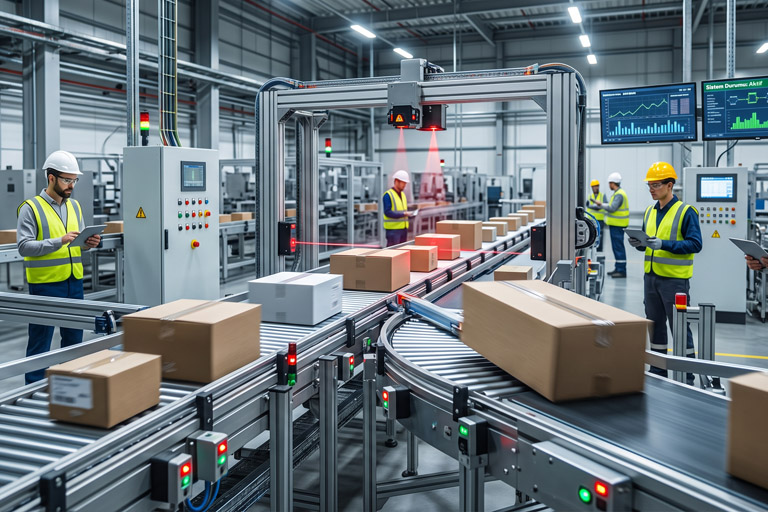
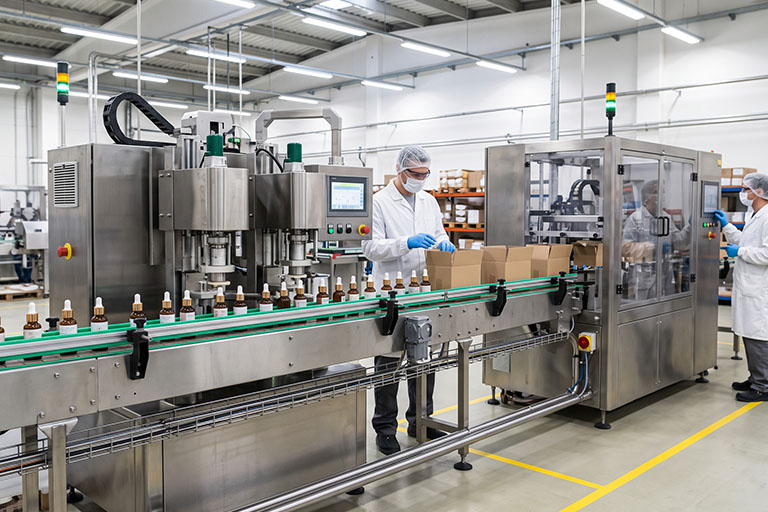
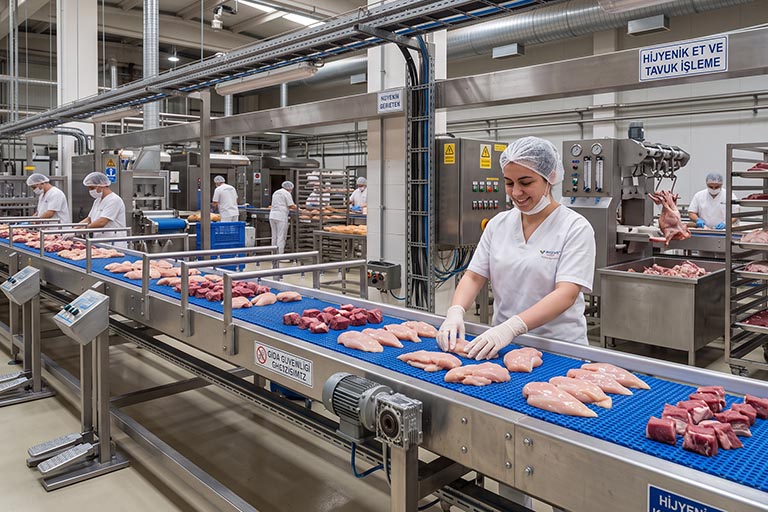
We produce durable, efficient, and innovative machines.
-
Esenyurt / İstanbul


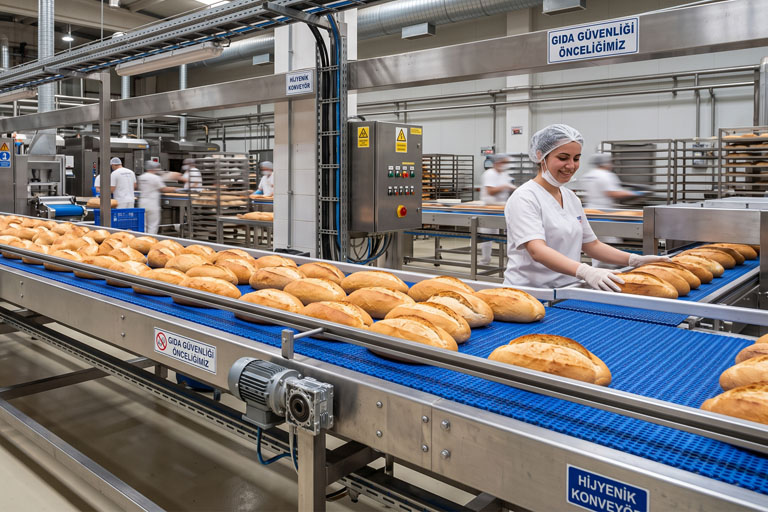
What Should You Consider When Selecting a Food Conveyor Belt?
When selecting a food conveyor belt, focusing only on belt width, length, or load capacity is not sufficient. Many factors, including product characteristics, production line speed, hygiene requirements, temperature, moisture, cleaning procedures, and integration with packaging systems, should be evaluated together. An incorrectly selected conveyor belt can lead to product losses, production downtime, increased maintenance costs, and hygiene issues.
As Arpack Machinery, we provide engineering solutions tailored to project requirements for the food conveyor belt systems, automatic feeding systems, and packaging lines we develop as a manufacturer.
What Is a Food Conveyor Belt?
A food conveyor belt is an industrial conveying system used to transport food products in a controlled manner between different stages of production, processing, transportation, cooling, sorting, and packaging.
Unlike conventional conveying systems, conveyor belts used in food production need to have suitable characteristics in terms of product contact, hygiene, cleaning, and operating conditions.
Food conveyor systems can be used in various production stages, including:
- Raw material transportation
- Product processing
- Cooling
- Product sorting
- Quality control
- Automatic feeding
- Packaging
Why Are Product Characteristics Important When Selecting a Food Conveyor Belt?
Not every food product requires the same transportation conditions. Using the same conveyor belt for biscuits, chocolate, bread, fruit, vegetables, meat, or frozen products may not always provide the desired results.
For example, vibration and impact control are important when transporting fragile biscuits, while hygiene, moisture resistance, and cleaning durability may be more critical in meat processing lines.
Therefore, the following questions should be evaluated first:
- Is the product solid or liquid?
- Is the product fragile?
- Is the product hot or cold?
- Does the product come into direct contact with the belt?
- What are the weight and dimensions of the product?
- What is the hourly production capacity of the line?
This information provides the basis for the correct food conveyor belt selection.
1. Belt Material and Food Contact Suitability
One of the most important criteria in food production is the belt material. Conveyor belts that come into direct contact with products should be manufactured from materials suitable for their intended application and applicable food-contact requirements.
Commonly used materials include:
- PVC
- Polyurethane (PU)
- Modular plastic
- Stainless steel
- Different coatings and surface materials for specialized applications
When selecting the belt material, factors such as product type, cleaning method, temperature, chemical exposure, and expected service life should be considered in addition to price.
2. Hygiene and Cleanability
The ability to clean a food conveyor belt easily is extremely important in food production.
The following features should be considered in conveyor belt design:
- Smooth and suitable surface structure
- Easily accessible components
- Design that minimizes product residue accumulation
- Materials suitable for cleaning procedures
- Components that can be easily removed when necessary
Especially in high-volume production facilities, the time required for cleaning directly affects production efficiency. Therefore, maintenance and cleaning processes should be considered as part of the design when selecting hygienic food conveyor belts.
3. Production Speed and Belt Capacity
The speed of the conveyor belt should be compatible with the other machines in the production line.
A conveyor that operates too slowly can create a bottleneck in the production line. On the other hand, an unnecessarily fast conveyor can cause uncontrolled product movement or alignment problems.
Especially in high-speed food production conveyor systems, the conveyor should be synchronized with the capacity of the packaging machines.
For this reason, the following factors should be evaluated together:
- Hourly production volume
- Belt speed
- Distance between products
- Packaging machine capacity
- Operating speed of the feeding system
4. Product Size and Weight
The dimensions and weight of the products being transported must be considered when selecting a conveyor belt.
The belt width can be determined according to different application scenarios, such as:
- Single-product transportation
- Multiple-product transportation
- Side-by-side product transportation
- Sequential product feeding
For example, the mechanical structure of a conveyor designed for small and lightweight products will not be the same as a system designed to transport heavy packages.
5. Product Fragility
Biscuits, crackers, cakes, and certain bakery products may break or become deformed during transportation.
Therefore, the following factors become particularly important when handling fragile products:
- Controlled belt speed
- Low vibration
- Smooth product transfers
- Appropriate belt surface
- Correct product spacing
When designing conveyor belt systems for fragile food products, the complete movement of the product from the beginning of the production line to the packaging point should be evaluated as a whole.
6. Temperature and Operating Conditions
Food products can be transported at different temperatures during production.
For example, a product coming directly out of an oven may have a high temperature, while frozen food production may involve operation at significantly lower temperatures.
Therefore, the belt material should be evaluated for resistance to:
- High temperatures
- Low temperatures
- Moisture
- Steam
- Oil
- Cleaning chemicals
Especially in baking, cooling, and freezing lines, temperature-resistant food conveyor belts should be selected according to the operating conditions of the application.
7. Conveyor Line Design
Not every production facility has a straight production line. Depending on the factory layout, products may need to change direction or be transported between different levels.
In such applications, the following conveyor types can be used:
- Straight conveyors
- Incline conveyors
- Turn conveyors
- Curved conveyors
- Multi-level conveying systems
Especially in facilities with limited production space, turn conveyor systems can help optimize the layout of the production line.
8. Compatibility with Automatic Feeding Systems
Simply transporting products is not enough for a conveyor belt. In modern production facilities, products need to reach the next machine at the correct position and speed.
For this reason, the conveyor system should operate in coordination with automatic feeding systems.
With an integrated structure:
- Product flow can be organized.
- Products can be aligned.
- Products can advance at predetermined intervals.
- Manual intervention can be reduced.
- Production continuity can be supported.
9. Integration with Flowpack Packaging Machines
Especially in packaged food production, synchronization between conveyor belts and flowpack packaging machines is highly important.
Products need to reach the packaging machine:
- At the correct speed
- In the correct position
- At the correct intervals
By operating the conveyor, feeding system, and flowpack machine together, bottlenecks in the packaging line can be reduced.
At Arpack Machinery, we place particular importance on evaluating these three components together when developing integrated systems.
10. Ease of Maintenance and Servicing
The ease of maintenance is just as important as the performance of a conveyor system.
If production needs to be stopped for an extended period during maintenance, the overall operating cost of the system may increase.
Therefore, the following criteria should be considered when selecting a conveyor system:
- Ease of belt replacement
- Access to motors and drive systems
- Maintenance of bearings and mechanical components
- Ease of cleaning
- Availability of spare parts
Industrial food conveyor systems should be designed for long-term operation, while maintenance and servicing processes should be made as straightforward as possible.
11. Automation Infrastructure of the Conveyor Belt System
In modern food production facilities, conveyors are an integral part of the production line’s automation system.
With sensors and control systems:
- Product presence can be detected.
- Product flow can be controlled.
- Belt speed can be adjusted.
- Machines within the production line can be synchronized.
- The system can be stopped in case of an error.
A PLC-based control infrastructure can contribute to more controlled conveyor operation, particularly in high-speed production and packaging lines.
12. Selecting a Conveyor According to Production Capacity
When selecting a food conveyor belt, it is important to consider not only the current production capacity but also potential future capacity increases.
For example, if a facility currently produces a certain quantity of products per hour but plans to add a new packaging machine in the future, designing the conveyor infrastructure to accommodate this potential capacity increase can provide operational advantages.
This approach can reduce the need for redesign when additional machinery or production line investments are made in the future.
Common Mistakes When Selecting a Food Conveyor Belt
Some common mistakes that can lead to an unsuitable conveyor selection include:
Selecting Based Only on Price
A low initial purchase price does not always mean a low total operating cost.
Ignoring the Product
Selecting a conveyor without considering the product’s weight, fragility, temperature, and physical characteristics can lead to performance problems.
Considering the Packaging Machine Too Late
Compatibility between the conveyor and flowpack or other packaging machines should be planned from the beginning.
Overlooking the Cleaning Process
Cleaning and maintenance procedures should be considered during the conveyor design stage in food production facilities.
Failing to Consider Future Capacity
A system that becomes insufficient as production capacity increases may require additional investment in the future.
Food Conveyor Systems with Arpack Machinery
At Arpack Machinery, we evaluate food conveyor belts, automatic feeding systems, and packaging machines not as independent pieces of equipment, but as integrated systems that form a complete production line.
As a manufacturer, we can engineer conveyor systems according to:
- Product characteristics
- Production capacity
- Line speed
- Factory layout
- Packaging system
- Automation infrastructure
We develop food production line conveyor solutions for a wide range of applications, from food production and bakery products to snacks and automated packaging lines.
When selecting a food conveyor belt, product characteristics, belt material, hygiene, load capacity, production speed, temperature, ease of maintenance, and automation compatibility should all be evaluated together. Especially in high-speed production and packaging lines, a conveyor system is not simply a piece of equipment for transporting products; it is an important automation component that directly contributes to the efficiency of the production line.
As Arpack Machinery, we develop food conveyor belt systems, automatic feeding systems, and flowpack packaging solutions according to the requirements of each production line and provide them as integrated solutions. Through proper engineering and the right conveyor selection, the goal is to organize product flow, support production continuity, and improve the efficiency of packaging processes.